A new start for your old car
Free Scrap & Junk Car Value Calculator in Canada
Request a free offer for your car, SUV, truck or van. Tell us about its condition and location, and we will contact you by phone or email to discuss an offer. The form requests an assessment; it does not display an instant price.
Request my free quote
Tell us what you have. We’ll discuss the offer with you.
Free quote · Free towing with an accepted purchase · Cash on the spot
Same-day pickup is available in many areas of British Columbia, Ontario, Alberta, Saskatchewan and Quebec, subject to location and scheduling.
For illustration, a sedan could receive $150–$800, an SUV $300–$1,500, a truck $500–$2,500, or a van $250–$850. These hypothetical CAD ranges are examples, not current market averages or guaranteed offers. Your vehicle’s offer can fall outside them.
From enquiry to collection
How does the free scrap car value calculator work?
Our free scrap car value calculator collects the details needed to discuss your vehicle’s value. We contact you with an offer, arrange an agreed visit and check the vehicle. You confirm the purchase amount before payment and free towing.
- 01
Describe your vehicle
Enter its year, make, model and condition. Tell us whether it starts, whether parts are missing and where it is parked.
- 02
Discuss your offer
We contact you by phone or email to discuss the vehicle and an offer. Your description, location and current market conditions inform the assessment.
- 03
Arrange a visit
We agree on a collection time with you. Tell us about access restrictions before the visit, including locked gates, underground parking or missing wheels.
- 04
Confirm the purchase
We inspect the vehicle and confirm the amount with you. Once you accept the purchase, we pay cash on the spot and tow the vehicle away for free.
Illustrations, not instant prices
How much could your scrap car be worth?
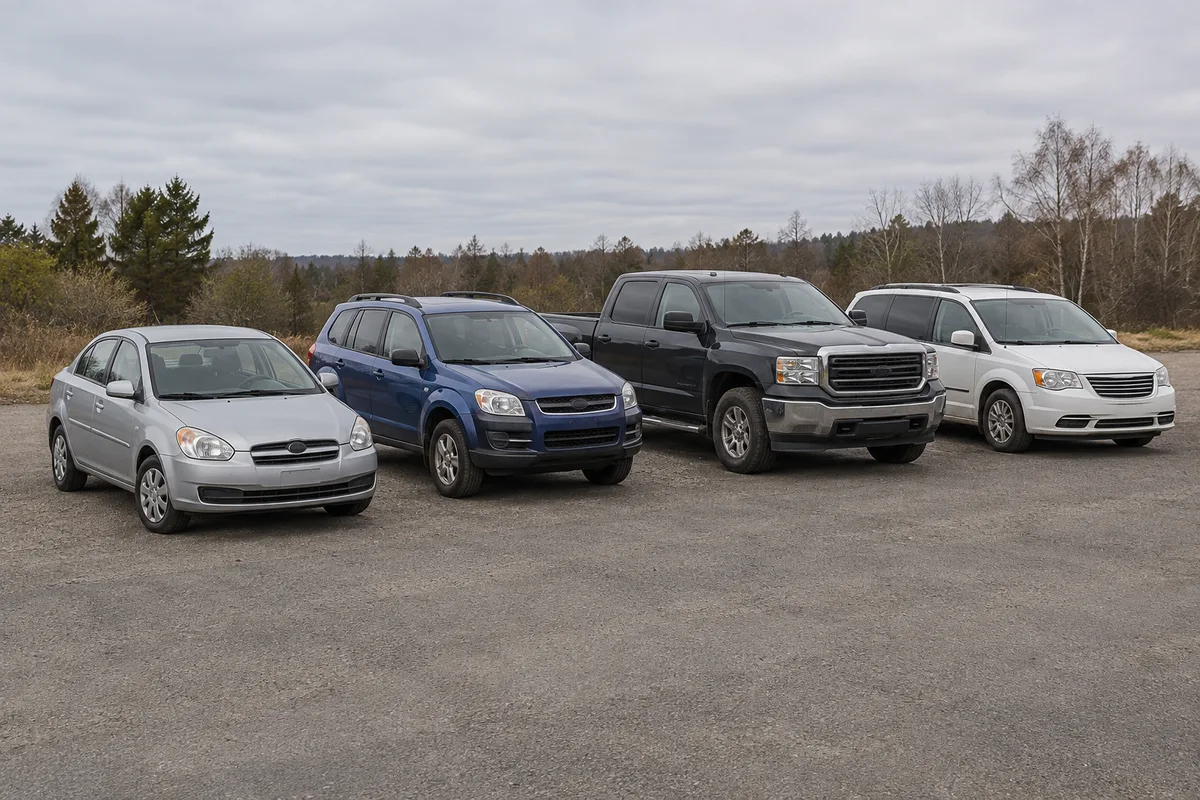
Your vehicle needs an individual assessment because its condition and recoverable components affect the offer. The hypothetical ranges below illustrate different vehicle categories. They do not establish a minimum payment, a maximum payment or the price of your vehicle.
Hypothetical vehicle-category ranges — all amounts are in CAD.
| Vehicle category | Illustrative range |
|---|---|
| Sedan | $150–$800 |
| SUV | $300–$1,500 |
| Truck | $500–$2,500 |
| Van | $250–$850 |
These ranges are not drawn from a current market dataset. A complete vehicle with usable components and a stripped vehicle require different assessments, even when both belong to the same category.
Before you enquire
What details do you need for a free offer?
Provide your vehicle’s year, make, model, condition and pickup location, together with a way to contact you. An accurate description helps us discuss the offer and collection arrangements. You do not need to calculate its metal weight before enquiring.
- Enter the vehicle’s year, make and model.
- Describe starting problems, damage and missing components.
- Provide the city, province and postal code where the vehicle is located.
- Provide the contact details requested in the form and choose whether you prefer a phone call or an email.
- Mention any uncertainty about ownership documents or access to the vehicle.
Tell us when you do not know a detail rather than guessing.
Request My Free Quote
We will contact you after reviewing your details. Submitting your enquiry does not confirm a sale or book a pickup appointment.
Request my free quoteThe details behind an offer
How is scrap car value assessed?
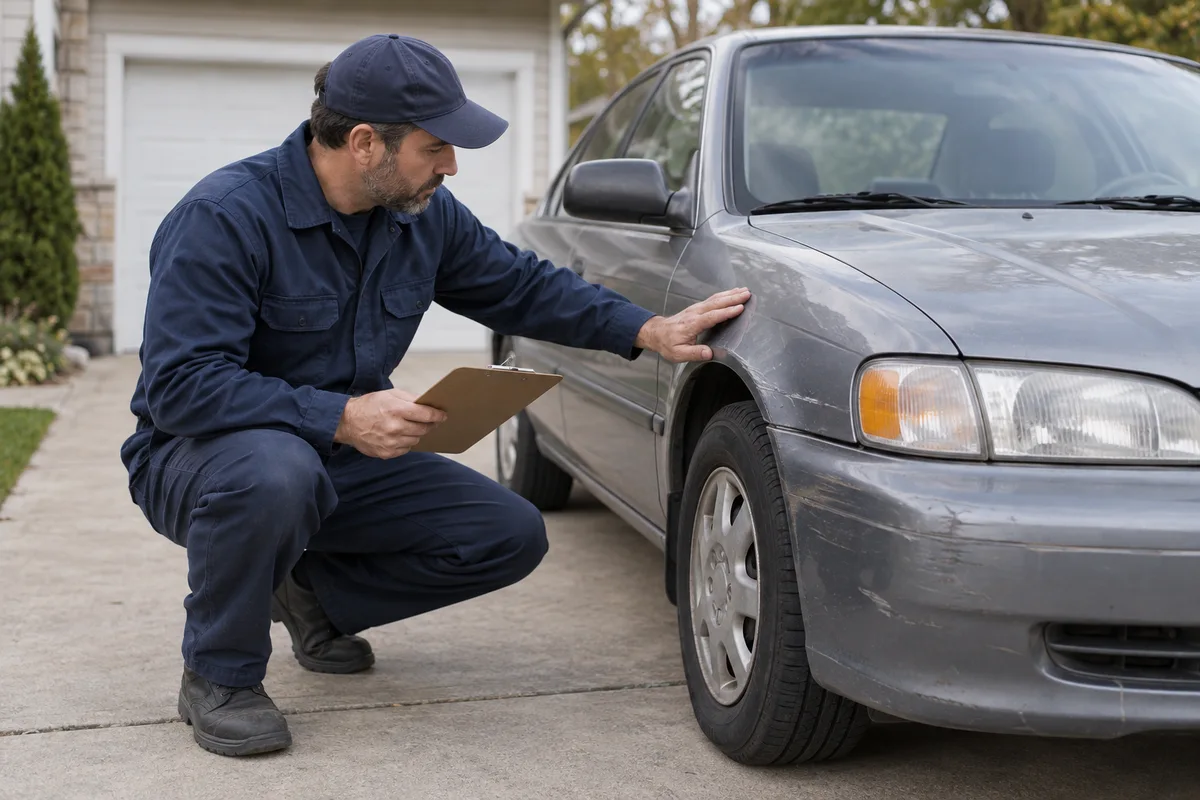
A scrap car assessment considers recoverable materials, reusable components, vehicle condition and location. The vehicle’s total weight is not the same as its recoverable metal weight. An individual offer also reflects the buyer’s assessment of demand and recovery costs.
The assessment considers these related details:
- Recoverable materials: The vehicle contains metal alongside glass, plastics, upholstery and other materials.
- Reusable components: A component’s condition and suitability for reuse affect how it contributes to the assessment.
- Vehicle condition: Damage, missing parts and starting problems help explain what can be recovered.
- Location and access: The pickup address and collection requirements inform the arrangements.
Our guide explains the factors that affect scrap car value in more detail. The arithmetic below illustrates one part of the assessment; it is not a formula run by this enquiry form.
Compare a complete vehicle with a stripped shell using the vehicle value factors guide. It explains which condition, component and access details help describe the car accurately. You do not need to weigh or dismantle the vehicle before requesting an assessment.
Understand your vehicle’s value
What do hypothetical prices per tonne show?
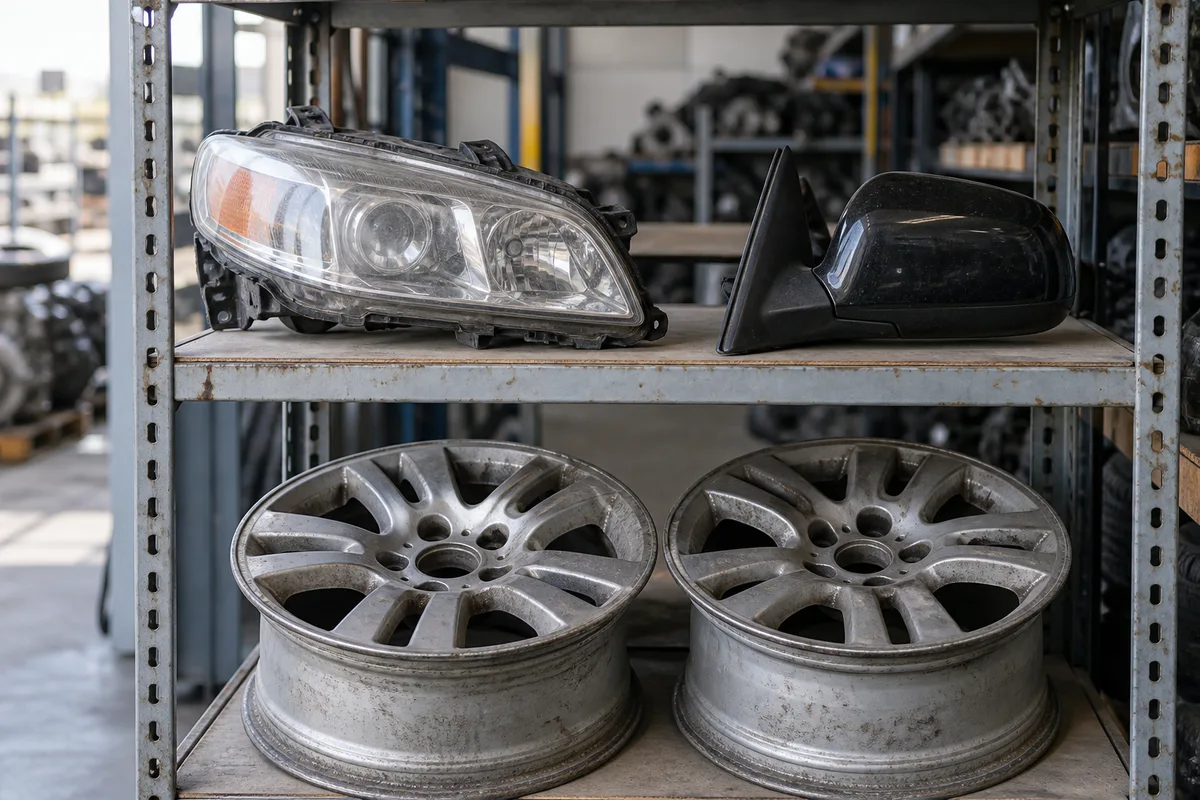
A per-tonne example shows how an assumed material weight and rate produce an illustrative subtotal. This page uses metric tonnes, with 1 tonne equal to 1,000 kilograms. The inputs below are hypothetical and do not represent current Canadian rates.
Illustrative metal subtotal = assumed recoverable-metal tonnes × assumed CAD rate per tonne.
| Assumed recoverable-metal mass | Hypothetical rate | Illustrative metal subtotal |
|---|---|---|
| 0.9 tonnes | $200 per tonne | $180 |
| 1.2 tonnes | $250 per tonne | $300 |
| 1.6 tonnes | $300 per tonne | $480 |
These figures use recoverable-metal mass, not the whole vehicle’s weight. They are neither offers nor predictions of what you will receive.
The scrap-value calculation guide explains unit conversion and component double counting. Keep an assumed material quantity separate from the car’s full curb weight, and do not add a reusable component twice by including it in both the parts amount and the material subtotal.
Understand your vehicle’s value
How can offers differ between provinces?
Offers depend on the vehicle, its location and the assessment conditions. The examples below place different hypothetical vehicles in five provinces. Their totals come from the stated assumptions, so they cannot establish which province pays more or compare provincial averages.
Hypothetical vehicle scenarios by province — these are invented examples, not local price data.
| Scenario location | Assumed vehicle and calculation | Illustrative total in CAD |
|---|---|---|
| British Columbia | Sedan: 0.9 recoverable-metal tonnes × $200, plus $70 in separate net component value | $250 |
| Ontario | Damaged SUV: 1.2 recoverable-metal tonnes × $250, plus $250 in separate net component value | $550 |
| Alberta | Truck: 1.6 recoverable-metal tonnes × $300, plus $420 in separate net component value | $900 |
| Saskatchewan | Sedan with the same assumptions as the British Columbia example | $250 |
| Quebec | Van: 1.1 recoverable-metal tonnes × $200, plus $80 in separate net component value | $300 |
The two sedan examples produce the same total because their inputs are identical. A province name alone does not determine an offer. The separate component amounts exclude materials already counted in each metal subtotal.
You can read more about scrap car price factors in Ontario and scrap car price factors in British Columbia. Both routes lead back to the same national offer-request process.
Understand your vehicle’s value
How can make, model and condition affect an offer?
Make, model and year help identify the vehicle, while its condition describes what is available for recovery or reuse. The model examples below use invented conditions and ranges. They are not quotations for every vehicle carrying the same model name.
Hypothetical model examples — the amounts are not model-specific market averages.
| Model example | Hypothetical condition | Illustrative CAD range |
|---|---|---|
| Honda Civic | Non-running; engine and converter present | $200–$400 |
| Toyota Corolla | Non-running; complete body and drivetrain | $200–$450 |
| Ford F-150 | Body damage; engine and transmission present | $500–$1,200 |
| Dodge Grand Caravan | High mileage; complete vehicle with worn interior | $250–$550 |
| Chevrolet Silverado | Non-running; complete drivetrain and body | $500–$1,500 |
| Honda CR-V | Body damage; reusable components assumed | $300–$600 |
| Toyota Camry | Non-running; complete vehicle | $250–$500 |
| Hyundai Elantra | Mechanical fault; engine and converter present | $150–$350 |
| Toyota RAV4 | Body damage; reusable components assumed | $300–$700 |
| Nissan Rogue | Non-running; complete vehicle | $250–$650 |
| Ford Escape | Mechanical fault; complete body and drivetrain | $250–$650 |
| Mazda3 | Non-running; engine and converter present | $200–$450 |
A component’s presence does not establish that it works or has a particular resale value. Your vehicle’s year, configuration and actual condition need review before an offer can be discussed.
Collection & free towing
Where is pickup available, and is towing free?
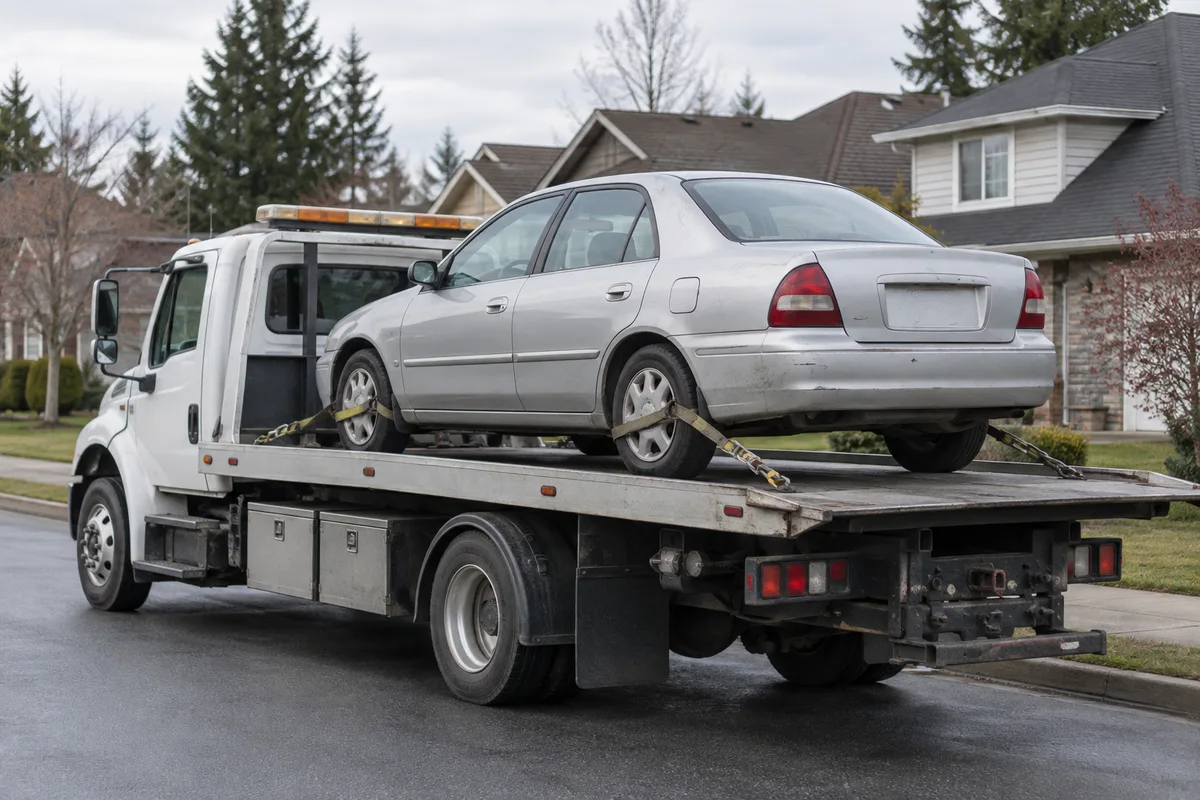
We arrange collection in British Columbia, Ontario, Alberta, Saskatchewan and Quebec. Free towing comes with an accepted purchase. Same-day pickup is available in many areas, subject to your location and scheduling. We confirm the pickup arrangements with you before the visit.
Use the relevant province page for coverage and preparation information:
- British Columbia pickup information
- Ontario pickup information
- Alberta pickup information
- Saskatchewan pickup information
- Quebec pickup information
Provide your actual pickup location when requesting an offer. A province listing does not confirm a particular collection time for every address.
See the arithmetic
What does an example vehicle valuation include?
A simplified example can combine an assumed metal subtotal with a separate component allowance. The three scenarios below show that arithmetic using invented inputs. They are not completed sales, customer offers or a reproduction of the calculation used by a buyer.
- Example A
a non-running sedan
The scenario assumes 0.9 tonnes of recoverable metal at $200 per tonne, producing $180. A separate net component allowance of $70 brings the illustrative total to $250.
$250 illustrative CAD total - Example B
a damaged SUV
The scenario assumes 1.2 tonnes of recoverable metal at $250 per tonne, producing $300. A separate net component allowance of $250 brings the illustrative total to $550.
$550 illustrative CAD total - Example C
a truck with reusable components
The scenario assumes 1.6 tonnes of recoverable metal at $300 per tonne, producing $480. A separate net component allowance of $420 brings the illustrative total to $900.
$900 illustrative CAD total
Each component allowance covers items excluded from the metal subtotal. Counting a component in both amounts would inflate the example. Free towing with an accepted purchase means that the customer pays no towing charge; it does not mean that collection has no cost to the buyer.
Before you decide
Your questions, answered.
Why can a scrap car offer change?
An offer can change when new information changes the assessment. Inspection can reveal missing components or damage that was not described initially. Market conditions and buyer demand can also change between assessments. We confirm the purchase amount with you before completing the sale.
Give an accurate description of the vehicle, including known faults and missing parts. Ask what the discussed offer includes and what remains subject to inspection. A hypothetical table cannot replace those vehicle-specific details.
What is the difference between scrap, junk and salvage value?
On this page, scrap value refers to material recovery, while junk-car assessment can also consider reusable components. Salvage value describes remaining recoverable value in this disposal context. These terms do not, by themselves, establish a vehicle’s legal status or an offer.
| Term used here | Meaning in the assessment |
|---|---|
| Scrap value | The value considered for recoverable materials |
| Junk-car value | An assessment that can include materials and reusable components |
| Salvage value | Remaining recoverable value; the meaning depends on the transaction and context |
An insurance or registration classification is a separate question. Describe the vehicle’s condition and disclose any known write-off history when you enquire, rather than relying only on a label such as “junk.”
Read the junk car and scrap car comparison for the difference between everyday descriptions. Our salvage value guide explains why an insurance assessment and a purchase offer can differ.
What happens after you accept an offer?
We arrange an agreed visit and inspect the vehicle before confirming the purchase amount. You decide whether to accept that amount. Once the purchase is agreed, we pay cash on the spot and provide free towing from the agreed collection location.
Our service uses a licensed recycler network. You can read how the offer and pickup process works before submitting your details.
What paperwork do you need before collection?
Paperwork depends on your province and the type of transaction. Have your vehicle’s registration or ownership information available, and tell us about any missing documents before scheduling collection. Do not assume that identification alone establishes your authority to sell the vehicle.
Provincial processes are not interchangeable. For example, Alberta’s bill-of-sale guidance distinguishes private transactions from automotive-business transactions. In Quebec, SAAQ’s discarding guidance distinguishes a recycler receipt from a dealer-recycler transaction document.
Our guide to scrapping a car in Canada explains how to prepare for the process. Confirm the applicable paperwork and any registration or plate steps before handing over the vehicle.
Use the detailed British Columbia, Ontario, Alberta, Saskatchewan or Quebec scrapping guide for the relevant local procedure. Each guide covers the normal handover and the important exceptions. Tell us when the vehicle is registered in a different province from its collection address.
Is selling individual parts worth more than selling the whole car?
Individual parts sales and a whole-car offer involve different costs and work. Compare likely buyer interest, safe removal, storage and disposal of the remaining shell before choosing a route. A parts price advertised online does not establish what you will receive for your complete vehicle.
Read the private sale and removal service comparison before deciding which option fits your circumstances.
Take the next step
How do you request your vehicle’s offer?
Enter your vehicle details and pickup location in the free quote form. We will contact you by phone or email to discuss an offer and collection arrangements. Your enquiry starts that conversation; it does not commit you to a sale or confirm a pickup time.